ADDING A BATTERY TO EXISTING SOLAR
Get more from the solar panels you already have
In many homes, a battery can be added to an existing solar PV system so more of the electricity your panels generate is used at home rather than exported. An authorised installer will check your current set-up and recommend the right way to connect an AlphaESS SMILE-G3 battery.
What will you learn from this guide?
- Why add a battery to solar
- AC, DC and hybrid coupling
- What your installer will check
- How much storage you need
- Smart tariffs and backup
- Frequently asked questions
What a battery adds to an existing solar system
Solar panels generate most during the middle of the day, when many households use the least electricity. Without storage, much of that surplus is exported. A battery stores it for later.
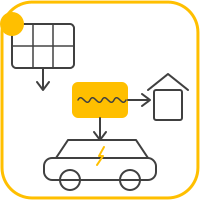
Use more of your solar
Store surplus daytime generation instead of exporting it.
Power your evenings
Use stored solar energy when household demand peaks.
Charge at lower-cost times
Top up from the grid on a suitable time-of-use or smart tariff.
Backup, where designed in
Keep selected circuits running during a power cut with compatible equipment.

Two main ways to connect a battery to your solar
How a battery connects depends mainly on your existing solar inverter. Your installer will recommend the approach that suits your system.
| Approach | How it works | Often suited to |
|---|---|---|
| AC-coupled | How it worksThe battery has its own inverter and connects alongside your existing solar inverter, which stays in place. | Often suited toSystems where the solar inverter is working well and you want to keep it |
| DC-coupled (hybrid) | How it worksA hybrid inverter manages both the solar panels and the battery, replacing the existing solar inverter. | Often suited toOlder solar inverters nearing the end of their life, or when other upgrades are planned |
The AlphaESS SMILE-G3 range supports both AC-coupled and DC-coupled designs, with single-phase and three-phase options.
What your installer will check
A site survey makes sure the battery is designed around your home, your existing solar and the way you use electricity.
-
Your existing solar inverter, its age and warranty
-
The size and output of your solar array
-
Metering, and any Feed-in Tariff or export arrangement
-
Your consumer unit and electrical arrangement
-
Network operator notification or application
-
Where the battery and any new equipment will be installed
How much battery storage do you need?
The right size depends on how much solar you generate, how much electricity you use in the evening and overnight, your tariff and whether you want backup. A bigger battery is not always better value if it rarely fills or empties.
SMILE-G3 batteries are modular, with battery modules of 4.0, 4.8, 9.6 and 10.1 kWh, so capacity can be matched to your home and, where supported, added to later. The home battery storage guide explains sizing in more detail.
Make your solar and battery work harder
Adding a battery also opens up smart and time-of-use tariffs. AlphaESS systems work with Octopus Energy, including Intelligent Octopus Flux, and can take part in grid flexibility through Axle Energy.
Backup power is available with compatible equipment and must be designed into the installation. Your installer will confirm which circuits can be backed up. You can monitor your solar, battery and energy use in the AlphaCloud app.
Frequently asked questions
Quick answers to common questions about adding battery storage to existing solar panels.
Most grid-connected solar PV systems can have a battery added, but the best approach depends on your inverter, array, metering and electrical arrangement. An authorised installer will confirm this during a survey.
Not always. With an AC-coupled battery, your existing solar inverter usually stays in place. If your inverter is older or due for replacement, a hybrid inverter that manages both solar and battery may be the better option.
It can depend on how your generation and export are metered. Your installer will check your metering, and you should confirm any changes with your Feed-in Tariff or export tariff provider before installation.
SMILE-G3 systems are modular, so additional battery modules can often be added later, within the limits of the system. Your installer can plan for future expansion at the design stage.
Yes, a battery normally needs to be notified to, or approved by, your local network operator. Your installer will usually handle this for you.