Commercial and Industrial Battery Storage
AlphaESS combines scalable commercial battery storage, intelligent energy management and dedicated UK technical expertise. Designed around each site’s load profile, generation, infrastructure and commercial objectives, our systems can support peak demand management, greater use of on-site renewable energy, operational resilience and a more flexible energy strategy.

Energy storage engineered for demanding operations
Commercial and industrial sites face changing electricity prices, demand peaks, grid constraints and growing electrification requirements.
AlphaESS battery storage can help organisations manage site demand, make greater use of on-site generation, respond to selected tariff periods and support defined resilience priorities. The right outcome depends on detailed energy data, system design, grid requirements and a clear commercial strategy.
Precision design and build around your energy strategy
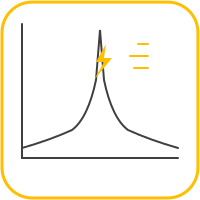
Manage peak demand
Charge and discharge stored energy around defined periods of high site demand. Potential savings depend on the site profile, electricity contract, applicable charges and configured operating strategy.
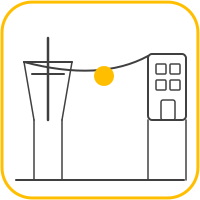
Make greater use of on-site generation
Store compatible solar or other on-site renewable generation for use when site demand is higher or generation falls.

Predictable operational costs
Schedule charging and discharging around compatible time-of-use or dynamic energy arrangements, subject to the selected system, tariff and integration.

AlphaESS StaX M29.9/50
AlphaESS STORION-H30/H50
AlphaESS STORION-LC-TB125
Installer voices
You don't need to take our word for the reliability and ease of installation of our battery energy systems. Please read what our Installers say about AlphaESS.
EcoSheffield

Customer Review

Install Review

Cardiff Current Electrical
A commercial battery energy storage system stores electricity for use according to the site’s operating strategy. It can charge from compatible on-site generation or from the grid during selected periods, then discharge when demand, electricity prices or operational requirements make stored energy more valuable.
The available functions depend on the battery system, metering, controls, grid connection and energy contract.
Battery storage can help a business make greater use of lower-cost electricity, reduce grid imports during selected peak periods and use more on-site renewable generation.
It may also help manage demand peaks and applicable capacity-related charges. Actual savings depend on the site’s consumption, generation, electricity contract, operating strategy, project costs and system performance.
No. A suitable commercial battery can charge from the grid and operate without solar panels. It can also be integrated with compatible new or existing solar PV, wind generation or other on-site energy assets.
The approved configuration depends on the selected equipment, existing infrastructure, metering and grid connection.
The appropriate system depends on electricity consumption, peak demand, operating hours, on-site generation, grid capacity and the intended operating strategy.
Future requirements such as electric vehicle charging, electrified heating, new equipment or site expansion should also be considered. Half-hourly energy data is normally required to assess suitable power and capacity.
It can where compatible backup equipment and an approved switching arrangement are included in the system design.
The supported loads, available power and backup duration depend on battery capacity, stored energy, equipment ratings and site priorities. Backup should be designed around clearly identified essential loads rather than assumed to support the whole site.
AlphaESS commercial storage systems incorporate product-specific safety measures that can include lithium iron phosphate battery chemistry, battery monitoring, thermal management, alarms and automatic protection controls.
Safe operation also depends on appropriate site selection, electrical design, fire strategy, access, installation, commissioning, monitoring and maintenance. The requirements must be assessed for the selected product and site.
Eligible systems may be able to participate in approved optimisation or flexibility services through a suitable integration partner. Eligibility depends on system capacity, metering, communications, site operation, electricity arrangements and the requirements of the selected service.
A useful initial assessment normally requires half-hourly electricity data, tariff information, details of existing or planned generation, grid connection information, site constraints and the organisation’s commercial and resilience objectives.